Picture this: It’s 2:00 AM. You’ve just spent the last four hours pouring your soul into an essay, a blog post, or a critical client report. Your eyes are burning, your coffee cup is empty, and you are running purely on adrenaline and sheer willpower. You finally hit submit, feeling that deep, quiet satisfaction that only comes from hard, honest work.
Then, the email comes back. Or the dashboard updates.
“AI Probability: 94%.”
Your stomach drops. You didn’t use AI. You wrote every single word yourself. But the glowing red bar on the screen is telling your professor, your boss, or your editor that you are a fraud.
If this scenario sounds familiar, you aren’t alone. In 2026, the anxiety surrounding Artificial Intelligence and written content has reached a fever pitch. We are living in a bizarre era where human beings are routinely forced to prove their own humanity to algorithms that are, frankly, guessing.
But here is the secret that the multi-million-dollar AI detection industry doesn’t always put on their homepage: AI text detectors are not lie detectors. They do not possess a magical ability to look into the “soul” of a text and see who wrote it. They are simply statistical pattern matchers. And like all pattern matchers, they are deeply flawed, easily confused, and constantly playing catch-up.
If you want to survive the modern digital landscape—whether you are a student, a freelancer, a marketer, or just someone who writes emails—you need to understand exactly how these tools work, why they fail, and how to protect yourself. Let’s pull back the curtain.
The Great Panic: How We Got Here
To understand the tech, we have to look at the history. When large language models (LLMs) first exploded into the public consciousness in late 2022, the internet essentially broke. Suddenly, anyone with a Wi-Fi connection could generate a 3,000-word essay on the French Revolution or a highly convincing marketing email in about four seconds.
Panic ensued.
High school teachers threatened to fail entire classes. Universities scrambled to rewrite their honor codes. Content mills and digital marketing agencies feared for their very existence. In the vacuum of that panic, a new industry was born overnight: The AI Detector.
Companies rushed to build software that could scan a document and definitively say, “Yes, a robot wrote this,” or “No, a human wrote this.” It felt like a necessary shield. We needed a way to separate authentic human thought from machine-generated sludge.
But as we have moved deeper into the 2020s, the dust has started to settle, and the cracks in these detectors have become impossible to ignore. The tools that were supposed to be our digital gatekeepers are frequently catching the wrong people, while letting actual AI-generated text slip right through the cracks.
Why? Because they are trying to solve a philosophical question (“What is human creativity?”) using basic math.
Under the Hood: How AI Detectors Actually Work
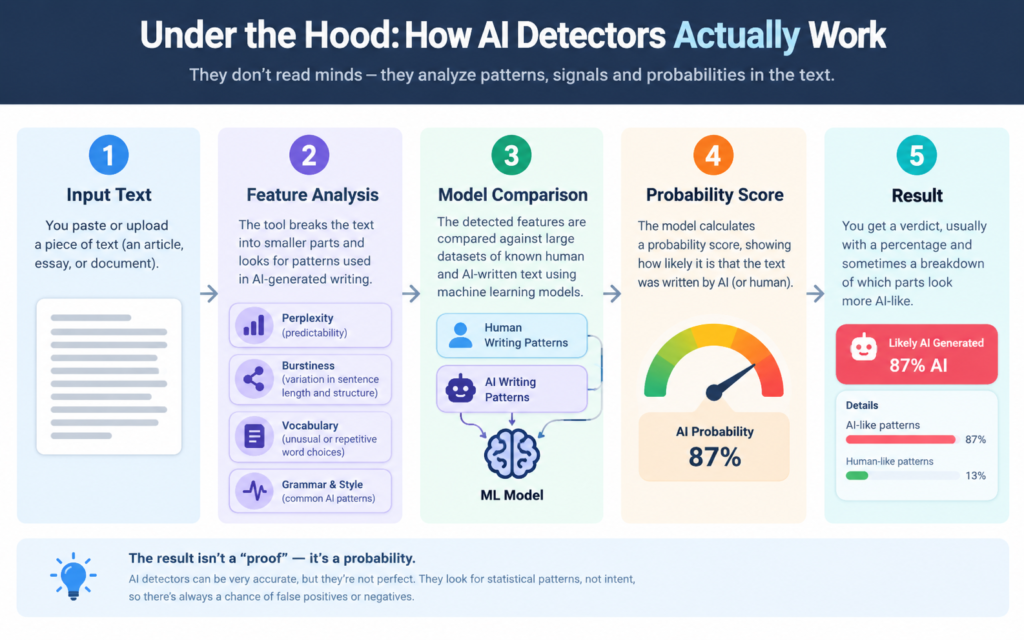
If you think an AI detector reads your text and analyzes the emotional depth, the nuance, or the originality of your ideas, you are giving it way too much credit. AI detectors do not “read” in the human sense. They calculate.
When you paste your text into an AI Text Detector, the software is primarily looking for two specific mathematical concepts: Perplexity and Burstiness.
Understanding these two terms is the key to understanding the entire AI debate.
1. Perplexity: How “Surprised” is the Algorithm?
Perplexity is a measurement of how unpredictable a piece of text is.
Imagine I start a sentence: “The quick brown fox jumps over the…”
If your brain immediately thought “lazy dog,” you just experienced low perplexity. That is the most statistically probable, predictable next word in that sequence.
Large Language Models are essentially giant prediction engines. They are trained on billions of pages of text, and when they generate a sentence, they are constantly choosing the next word that has the highest statistical probability of following the previous word. Because they always choose the “safest,” most predictable route, AI-generated text generally has very low perplexity. It is smooth, highly readable, and entirely unsurprising.
Human beings, on the other hand, are chaotic. We use weird metaphors. We invent slang. We use words in contexts that don’t strictly make mathematical sense, but make emotional sense. If I wrote, “The quick brown fox jumps over the… existential dread of a Tuesday afternoon,” an AI model would be highly “perplexed” because that is not a statistically probable sequence of words.
The Rule of Thumb: AI detectors look for text that is too smooth, too predictable, and too “average.” If your writing is highly predictable, the detector flags it as AI. If your writing is erratic, creative, and uses unusual vocabulary, the detector leans toward “Human.”
2. Burstiness: The Rhythm of Your Sentences
If perplexity is about word choice, burstiness is about sentence structure.
Think about how a machine writes. It likes consistency. An AI will typically generate a paragraph where every sentence is roughly 15 to 20 words long. It follows a very standard Subject-Verb-Object cadence. It is a steady, monotonous drumbeat. Tap. Tap. Tap. Tap.
Now, think about how you write when you are passionate about a topic.
You might write a very long, rambling sentence that goes on for forty words, weaving through three different tangents, using commas and em-dashes to keep the thought alive, because you are just so excited to get the idea out of your head and onto the page. Then? You stop. Short sentence. Fragment. Boom.
That variation is burstiness. Human writing is incredibly “bursty.” We alternate between long, complex, multi-clause sentences and incredibly short, punchy ones. We use rhetorical questions. We break grammatical rules for stylistic effect.
AI detectors map out the length and structure of every sentence in your document. If the graph looks like a flat, steady line, the algorithm assumes it was generated by a machine. If the graph looks like a chaotic heart monitor with massive spikes and deep drops, it assumes a human wrote it.
The “False Positive” Epidemic
Once you understand perplexity and burstiness, the dark side of AI detectors becomes glaringly obvious. Because these tools are just looking for mathematical predictability, they end up punishing people who write in a clear, structured, or formal manner.
The false positive rate (where human writing is incorrectly flagged as AI) is a massive, largely unaddressed problem in 2026. Who gets caught in the crossfire?
Non-Native English Speakers
This is perhaps the most heartbreaking casualty of AI detectors. When people are writing in their second or third language, they naturally tend to rely on standard, formal, and highly predictable sentence structures. They avoid obscure slang or chaotic sentence variations because they are focusing on being grammatically correct. Ironically, this “correctness” results in low perplexity and low burstiness, causing detectors to flag their hard-earned essays as AI-generated.
Technical, Legal, and Academic Writers
If you are writing a scientific paper, a legal contract, or a standard operating procedure (SOP) for a business, you should not be using wild metaphors or chaotic sentence structures. Technical writing requires precision, standard terminology, and predictable formatting. Because scientific writing is inherently low-burstiness, researchers and students in STEM fields are disproportionately flagged by AI detectors, even when they are writing 100% from scratch.
Neurodivergent Writers
Many neurodivergent individuals, including those on the autism spectrum, may naturally communicate in highly structured, systematic, and direct ways. When their natural communication style aligns with the mathematical patterns of an LLM, detectors unfairly penalize them.
The real-world consequences of this are severe. Students have lost scholarships. Freelancers have lost clients. Writers have been publicly accused of cheating, with nothing but a flawed, black-box algorithm serving as the “evidence.”
The 2026 Arms Race: Why Detectors Are Losing
If AI detectors are just looking for low perplexity and low burstiness, the logical next step is for AI models to simply… stop writing that way. And that is exactly what has happened.
We are currently in the middle of a digital arms race between AI Generators and AI Detectors, and frankly, the generators are winning.
Modern LLMs are no longer just spitting out the most statistically probable word. They can be fine-tuned and prompted to mimic human chaos. Users are now giving prompts like:
- “Write this article with high burstiness and high perplexity.”
- “Vary your sentence length dramatically, and use occasional colloquialisms.”
- “Write this in the style of a slightly cynical, conversational blogger.”
When an AI is prompted this way, it intentionally injects randomness into its output. It uses weird metaphors. It writes a three-word sentence followed by a fifty-word sentence. It bypasses the detector’s math.
Furthermore, the rise of AI Humanizers has completely disrupted the detection industry. These tools take a piece of AI-generated text and run it through a thesaurus-on-steroids, swapping out predictable words for unpredictable synonyms and deliberately breaking up sentence structures to manufacture “burstiness.”
Because of this, many AI detectors in 2026 are essentially flipping a coin. They will flag a beautifully written, deeply human essay as “90% AI,” while giving a “100% Human” score to a machine-generated article that was run through a humanizer tool.
This creates a cynical environment where the goal is no longer “write good content,” but rather “trick the math equation.”
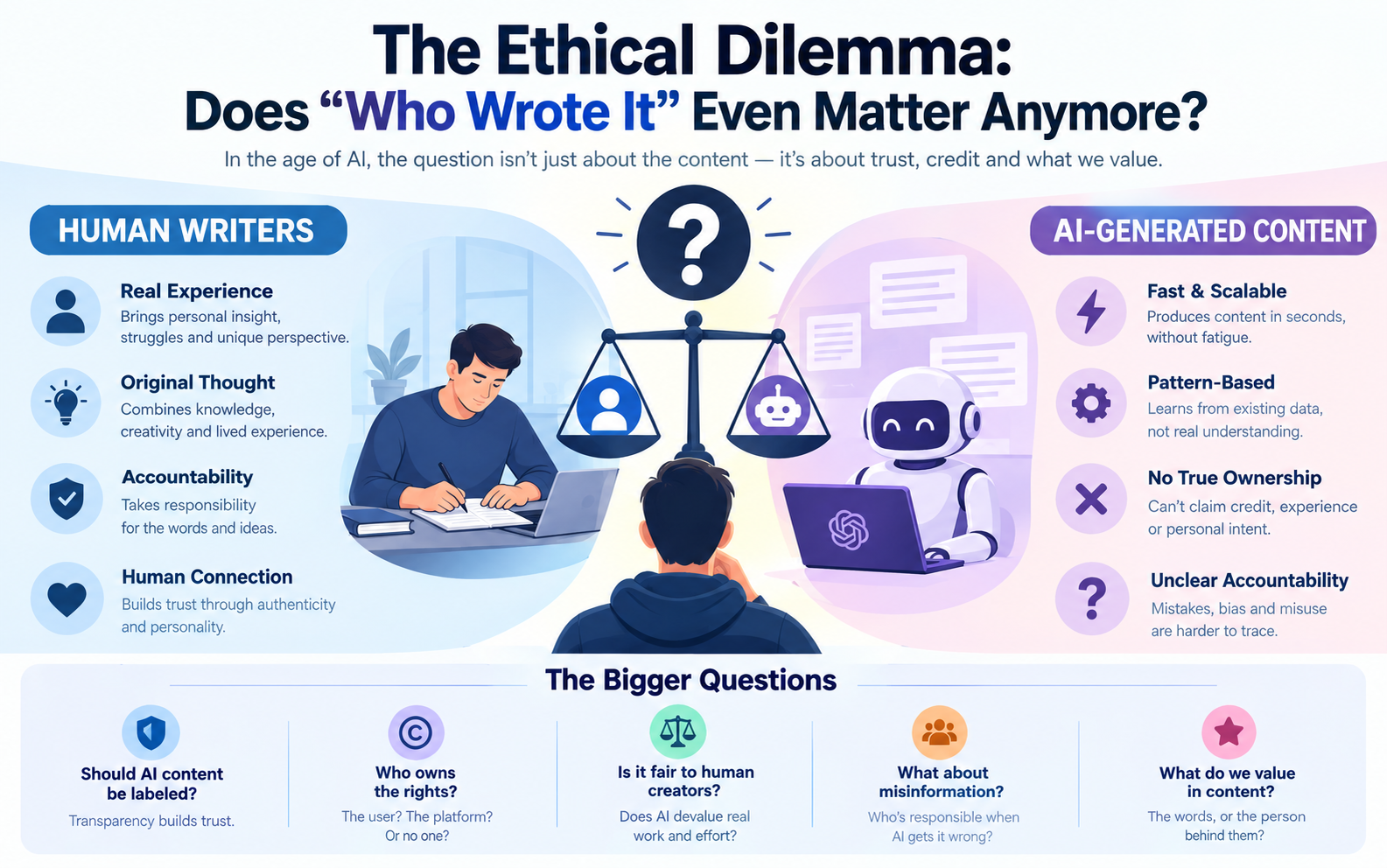
The Ethical Dilemma: Does “Who Wrote It” Even Matter Anymore?
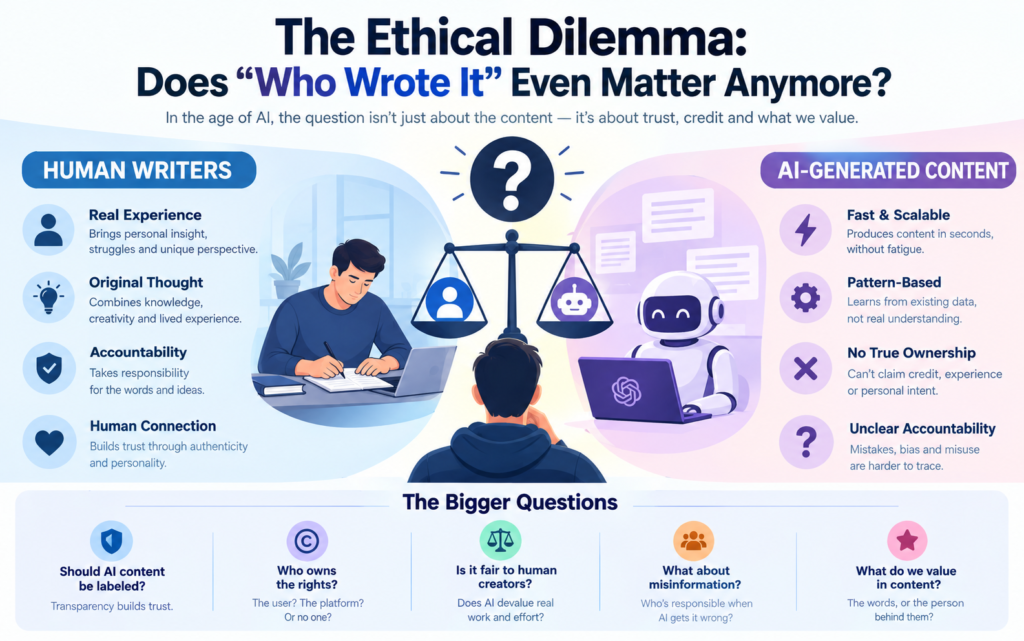
All of this technical back-and-forth forces us to ask a much deeper, more uncomfortable question: Why do we care so much?
In the early days of the AI boom, the fear was that machines would replace human thought entirely. But as we integrate these tools into our daily lives, the line between “human-written” and “AI-written” is becoming incredibly blurry.
Think about your own workflow.
- If you write a terrible, messy first draft, and use AI to fix the grammar and organize the paragraphs… is it AI?
- If you use AI to brainstorm ten ideas, pick your favorite, and write the whole thing yourself… is it AI?
- If you dictate your thoughts into a voice-to-text AI, which then formats them into an essay… who is the author?
We are rapidly moving toward a consensus in the professional and academic worlds that policing the origin of the text is a losing battle. Instead, the focus is shifting toward policing the value of the text.
Did the writer do the original research? Are the facts accurate? Is the core idea original? Does the piece offer a unique perspective that a machine, which only regurgitates existing internet data, could not possibly conceive?
In 2026, using AI as a co-pilot for outlining, formatting, or editing is becoming as standard as using spell-check was in 2010. The ethical breach isn’t in using the tool; the ethical breach is in lying about your sources, plagiarizing ideas, or publishing unverified, hallucinated facts.
Transparency is becoming the new standard. Instead of hiding AI usage and hoping a detector doesn’t catch you, many professionals are simply adding a small note: “This article was outlined and edited with the assistance of AI tools, but all core research and final drafting were performed by a human.”
How to Protect Yourself in an Algorithmic World
So, where does this leave you? If you are a student, a blogger, or a professional writer, how do you protect yourself from the wrath of a false positive?
You cannot control the algorithms, but you can control your paper trail. Here is a survival guide for the modern writer.
1. Never Write in the Final Submission Box
This is the most common mistake people make. If you type your essay directly into a web portal, a learning management system (like Canvas or Blackboard), or a final email draft, you have zero proof of your process.
Always write in a cloud-based document (like Google Docs, Notion, or Microsoft Word Online). These platforms automatically save your Version History. If you are ever accused of using AI, you can pull up the version history and literally show the accuser the document evolving word-by-word over the course of three hours. A machine generates text in four seconds; a human types, deletes, rewrites, and edits over time. Version history is your ultimate alibi.
2. Keep Your “Trash”
Do not delete your messy brainstorming notes, your voice memos, or your terrible first drafts. Keep a “scratchpad” document where you dump your raw thoughts before you start writing the actual piece. If push comes to shove, showing your messy, chaotic brainstorming process is excellent proof of human cognition.
3. Use Detectors as a Mirror, Not a Judge
Should you use an AI detector on your own work before submitting it? Yes, but with a massive grain of salt.
Run your text through a reliable AI Text Detector as a sanity check. If it comes back as 100% Human, great. If it comes back as 40% AI, don’t panic. Read through the highlighted sections. Are those sections overly generic? Did you use a lot of cliché phrases? Use the detector as a mirror to help you inject more of your own unique voice, personal anecdotes, and “burstiness” into your writing.
4. Inject Your Humanity
The best way to beat a detector is to be undeniably human.
- Tell personal stories: An AI doesn’t know what happened to you at the grocery store yesterday.
- State strong opinions: AI models are heavily guarded to be neutral, balanced, and inoffensive. Don’t be afraid to take a firm, subjective stance on a topic.
- Use current, real-world context: Reference events, cultural moments, or highly specific niche knowledge that grounds the text in reality.
The Bottom Line
The era of AI text detection is messy, frustrating, and deeply flawed. We are trying to use 2020s mathematics to define the boundaries of human creativity, and it is simply not working.
AI detectors will continue to exist. They will get slightly better, and then the AI generators will get slightly better, and the dance will continue. But as a writer, a student, or a creator, you cannot let the paranoia of the algorithm strip the joy and authenticity from your work.
Write with your own voice. Embrace your chaotic sentence structures. Use your weird metaphors. Keep your version history close, and remember that at the end of the day, the value of your writing isn’t determined by a probability score on a screen. It’s determined by the connection you make with the human being reading it on the other side.
And no algorithm can measure that.

The Editorial Team
The Editorial Team at iqqbit.info creates practical, easy-to-use resources designed to make everyday tasks simpler. We focus on useful daily-life tools, helpful guides, and straightforward information that anyone can access and understand. Our goal is to provide reliable, free tools for everyday needs while also offering premium and customizable tool options for website owners who want to add useful features to their own websites. We believe useful technology should be simple, accessible, and genuinely helpful. At iqqbit.info, we continuously work to improve our tools, keep information clear, and create resources that save users time and effort.