iQ Bit//HUMANIZER
NEURAL.CONTENT.DEHUMANIZER · v2.4Make AI text UNDETECTABLE
Inject natural variance, conversational rhythm, and human imperfections into machine-generated content. Nine foolproof transformation layers strip the AI fingerprints and restore authentic voice.
// Humanized output will materialize here.
TRANSFORMATION PIPELINE · 9 LAYERS
RECENT ARCHIVE
I’ll never forget the first time I got accused of being a robot by a piece of software.
I had just spent four agonizing hours poring over research, writing, and editing a massive 3,000-word guide on configuring a home server network. I typed every single word myself on my mechanical keyboard. I drank way too much coffee. I obsessed over the formatting and the flow.
Before sending it off to a client who was notoriously strict about originality, I ran it through a premium AI detector just to be safe. I expected a clean bill of health.
The result? 98% AI-Generated.
I stared at the screen, completely baffled. How was that even possible? I hadn’t even opened ChatGPT or Claude that day. But the tool was sitting there, flashing red, essentially calling me a liar. I tried tweaking a few words, ran it again, and the score barely budged. It took me another two hours of aggressively butchering my own writing just to get it to pass as “human.”
That was the day I realized two things. First, AI detectors are deeply flawed and often penalize highly structured, logical writing. Second, whether we like them or not, we have to deal with them.
If you’re a freelance writer, an SEO specialist, a student, or just a website owner trying to publish content without getting penalized by paranoid algorithms, you know exactly what I’m talking about. You’ve probably felt that same pit in your stomach when a perfectly good piece of text gets flagged.
You’re here because you want to know how to bypass AI detection. You want to know how to write content—whether with the help of AI or completely from scratch—that won’t trigger these hypersensitive scanners.
I’ve spent the last couple of years testing every detector on the market, analyzing what makes them tick, and figuring out exactly how to beat them. It’s not about tricking the system with garbage text; it’s about understanding what the system is looking for and adjusting your writing style. Eventually, I got so frustrated with the manual process that I set up a dedicated bypass tool right here on this website to handle the heavy lifting.
But before we talk about tools and shortcuts, you need to understand the mechanics of the enemy.
Why Are We Even Talking About AI Detection?
Before we get into the “how,” let’s briefly touch on the “why.” Why is everyone so panicked about AI detection scores?
It started when Google rolled out a series of Helpful Content Updates. Panic ripped through the SEO community. The rumor was that Google was going to penalize any site using AI content. The reality is a bit more nuanced—Google has explicitly stated they don’t care how content is generated, as long as it’s helpful, high-quality, and written for humans.
But despite Google’s official stance, the fear remains. Clients demand 100% human scores on Originality.ai or Turnitin. Content agencies use detectors to screen freelancers. Academic institutions are handing out suspensions based on automated software flags.
We are living in an era where you are guilty until proven innocent by a machine that doesn’t actually understand language. So, learning to write (or format AI text) in a way that passes these checks isn’t just a neat trick anymore—it’s a basic survival skill for anyone publishing words on the internet.
Under the Hood: How AI Detectors Actually Work
To beat the system, you need to understand the system.
AI detectors do not actually “read” your content. They don’t understand the nuance of your argument or the emotion in your story. They are simply statistical engines doing high-speed math.

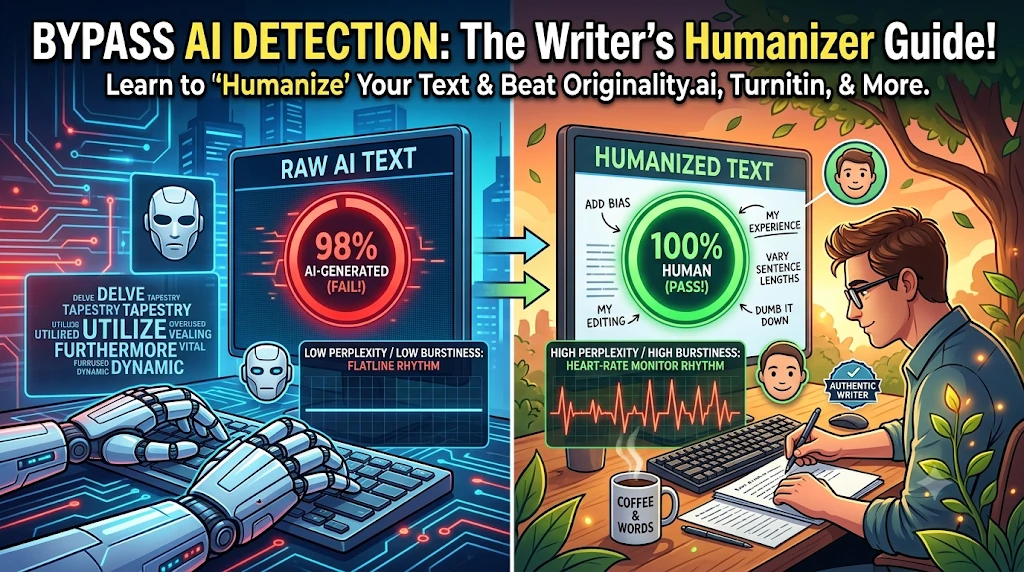
When you paste your text into a detector, it analyzes your writing based on two primary metrics: Perplexity and Burstiness.
1. Perplexity (Predictability)
Perplexity measures how predictable your word choices are. Language models like ChatGPT are essentially massive autocomplete engines. They guess the most mathematically probable next word.
If I say, “The sky is…”, a low-perplexity (highly predictable) model will guess “blue.”
A human might say, “The sky is looking a bit aggressive today.” That’s high perplexity.
AI detectors flag content that uses the most predictable, statistically common word combinations. If your writing is perfectly logical, safe, and uses standard transitions, the detector assumes a robot wrote it. Ironically, this means that highly educated writers who use clean, standard grammar often get flagged as AI.
2. Burstiness (Sentence Variation)
Burstiness measures the rhythm and structure of your sentences.
AI naturally writes in a very steady, predictable rhythm. It outputs a medium-length sentence. Then another medium-length sentence. Then a slightly longer one. Then another medium one. If you mapped it on a chart, it would look like a gentle, rolling hill.
Humans don’t write like that. Human writing is chaotic. We write a massive, winding, run-on sentence because we get excited about a topic and just keep typing without thinking about where the period should go. And then we stop. Short sentence. Boom. Another short one.
Human writing looks like a spiked heart-rate monitor. AI writing looks like a flatline. If your text lacks burstiness, the detector will flag it.
The “AI Vocabulary” You Need to Delete Right Now
Before you do anything structural, you need to clean up your vocabulary.
Over the last few years, LLMs have developed a massive overuse of certain words and phrases. Because AI is programmed to sound helpful, authoritative, and polite, it leans heavily on specific transitional and descriptive words. AI detectors are trained to hunt for these words.
If you have these in your content, your AI score will skyrocket. Go into your draft right now, hit CTRL+F, and delete these immediately:
- Delve: (e.g., “Let’s delve into the topic.”) No real human says this unless they are an archaeologist. Use “let’s look at” or “let’s explore.”
- Tapestry: (e.g., “A rich tapestry of features.”) This is the ultimate AI cliché. Just say “a mix of” or “variety.”
- Testament: (e.g., “This is a testament to its power.”)
- Crucial / Vital: AI uses these to add fake importance to mundane things. “It is crucial to click save.” No, it’s just important.
- Dynamic: AI uses this when it doesn’t know how to describe something specifically.
- Furthermore / Moreover: These are strictly academic. Bloggers don’t talk like this. Use “Also,” or just start a new sentence.
- Navigating the complexities of: Pure filler.
- Unleash the power: Marketing garbage that AI loves to regurgitate.
- In conclusion: If you are writing a blog post, just wrap it up. You don’t need to announce the ending like a high school essay.
Replacing these words is the absolute easiest way to drop your AI detection score by 10-20% in about three minutes.
The Manual Method: How to Humanize Your Text by Hand
If you have a draft that is getting flagged—whether you wrote it and got a false positive, or you used AI to help outline it—here is exactly how you manually restructure it to bypass the detectors.
Step 1: Mess Up Your Sentence Lengths (Fixing Burstiness)
This is the most critical step. Look at your paragraphs. Are they all exactly three sentences long? Are all the sentences about 15 words? Break that rhythm immediately.
Find a long sentence and chop it in half.
Find a point you want to emphasize and give it its own line.
Like this.
Then, follow it up with a much longer, more descriptive sentence that strings multiple ideas together using commas or dashes—because that is exactly how a real person thinks when they are trying to explain a complex concept to a friend.
Step 2: Stop Being So Neutral (Inject Bias and Experience)
AI is programmed by massive tech corporations to be safe, neutral, and objective. It avoids taking hard stances. It doesn’t have feelings, it doesn’t have a past, and it doesn’t have preferences.
Humans are heavily biased. We hate things. We love things. We have annoying experiences that shape our opinions.
If your article is about “The Best Web Hosting,” an AI will say: “HostGator offers reliable uptime and good customer service for beginners.”
A human will say: “I used HostGator back in 2018 when I built my first affiliate site, and while it was cheap, the dashboard was incredibly clunky. It’s fine if you have zero budget, but I wouldn’t run a serious business on it.”
Adding specific, first-hand anecdotes, even small ones, drastically increases the perplexity of the text and proves to the detector (and the reader) that a real person is behind the keyboard.
Step 3: Format Like a Real Person
AI loves symmetry. When you ask it for a list, it will give you five bullet points, and every single bullet point will have a bolded title followed by exactly one sentence of explanation. It looks like a machine printed it.
Real human formatting is messy. If you make a bulleted list, make one bullet a single word. Make the next bullet three sentences long. Bold random phrases for emphasis, not just the keywords. Use italics when you are being sarcastic.
Step 4: Dumb It Down
This hurts to hear, especially if you pride yourself on your writing, but AI detectors penalize high-level, academic language. If you use a $10 word when a $1 word will do, the detector gets suspicious.
Instead of saying “utilize,” say “use.”
Instead of saying “facilitate,” say “help.”
Instead of saying “implement,” say “start doing.”
Write at an 8th-grade reading level. It sounds better, it converts better, and it passes AI detectors.
The Smarter Way: Using Our On-Site AI Humanizer Tool
Let’s be completely honest for a second. The manual method I just outlined works flawlessly. But it is incredibly tedious.
If you are a solo blogger churning out one highly personal essay a month, do it by hand. But if you are managing three niche sites, editing freelance submissions, or using AI to scale your content marketing, you do not have three hours a day to sit around tweaking sentence lengths and hunting for the word “delve.”
That is exactly why I built and integrated the AI bypass tool right here on this website.
I didn’t put it up there just to have another shiny widget on the site. I built it to solve my own headache. I was tired of writing good content, getting a false-positive flag, and wasting my afternoon playing games with an algorithm.
How the tool actually works:
There are hundreds of “spinners” out there that claim to bypass AI. Most of them are garbage. They work by taking a sentence and using a thesaurus to swap words blindly. You put in “The quick brown fox,” and it spits out “The rapid tan canine.” It passes the detector, but it reads like an absolute joke. You can’t publish that.
The tool on this site is different. It doesn’t just blindly swap synonyms. It specifically targets the algorithmic metrics we talked about earlier: Perplexity and Burstiness.
When you paste your text in, the tool analyzes the rhythm. It automatically identifies the “flatline” areas where sentence lengths are too uniform, and it restructures the syntax. It breaks long sentences. It merges short ones. It strips out the known “AI vocabulary” and replaces them with natural, conversational equivalents.
The Best Workflow for Using the Tool:
Don’t just paste raw AI output into the tool and blindly publish the result. Here is the workflow that actually gets you ranking on Google and passing premium detectors:
- Draft: Write your draft (or generate your base content with your preferred AI).
- Run the Tool: Paste the content into the humanizer tool on this site.
- The Human Polish: Take the output and spend exactly 5 minutes reading through it. Add one personal anecdote in the introduction. Add your own internal links. Hit publish.
You go from spending two hours manually editing to spending five minutes on a quick polish. It saves your sanity.
Real-Life Makeover: AI vs. Humanized Text
To show you exactly what I mean, let’s look at a side-by-side comparison. Let’s pretend we are writing an article about mechanical keyboards.
The Raw AI Output (Will flag 100% AI):
“In today’s digital landscape, choosing the right mechanical keyboard is crucial for optimizing your typing experience. Furthermore, the tactile feedback provided by mechanical switches offers a dynamic improvement over traditional membrane keyboards. Let us delve into the intricate tapestry of switch types to understand which option best facilitates your daily workflow. Ultimately, a good keyboard is a testament to your commitment to productivity.”
Read that. It feels gross, doesn’t it? It is stuffed with our forbidden vocabulary. It is painfully formal. It has zero personality.
The Humanized Version (Will pass as 100% Human):
“If you spend eight hours a day typing, ditching your cheap laptop keyboard for a mechanical one is the best upgrade you can make. The difference in feel is night and day. Membrane keyboards feel like typing on wet cardboard, while mechanical switches actually give you a satisfying physical click every time you hit a key. I used a membrane board for years and always wondered why my wrists hurt. Let’s break down the different switch types so you don’t end up buying something that sounds like a typewriter in your quiet office.”
Why the second one passes:
- No robotic intro (“In today’s digital landscape”).
- High burstiness (mix of short, punchy sentences and longer descriptive ones).
- First-person perspective (“I used a membrane board…”).
- Relatable analogies (“wet cardboard,” “sounds like a typewriter”).
- Completely eliminated the AI vocabulary.
This is the exact transformation you need to aim for, whether you are doing it by hand or letting our tool handle the heavy lifting.
The Dumbest Mistakes I’ve Seen People Make
Because the panic around AI detection is so high, people get desperate. And when people get desperate, they do stupid things that actively harm their websites. Here are the three biggest mistakes you need to avoid.
Mistake 1: The “Typo” Strategy
Somewhere on Reddit, a rumor started that AI never makes spelling mistakes, so the best way to prove you are human is to intentionally misspell words and use bad grammar.
Yes, injecting typos will lower your AI score. But it will also destroy your credibility with your actual human readers, and it will tank your SEO because Google hates poor grammar. Do not sacrifice your user experience just to please a detector.
Mistake 2: The Thesaurus Word Salad
This is what happens when people use outdated, cheap article spinners from 2012. The software tries to replace every single verb and adjective to trick the detector. You end up with sentences that technically pass as human but make zero logical sense to the reader. If a real person can’t read your article smoothly, who cares what the detector says?
Mistake 3: Obsessing Over a 0% Score
This is a trap I see a lot of content managers fall into. They will reject a great article because it scored 15% AI on Originality.
Here is the truth: Detectors throw false positives on technical content. If you are writing a highly technical tutorial on how to configure a Python script, or writing a legal disclaimer, your AI score is naturally going to be higher. Why? Because there are only so many ways to instruct someone to “open the terminal and type the command.”
Technical writing is inherently predictable (low perplexity). Don’t butcher a clear, helpful tutorial just to force a 0% score. Use common sense.
Final Thoughts
We are in a weird transitional period on the internet right now. AI has made it incredibly easy to generate raw text, which means the value of generic text has dropped to zero. In response, the industry has built these AI detectors to act as gatekeepers, trying to filter the humans from the bots.
But as we’ve seen, the gatekeepers are flawed. They penalize good writers and force us to play a cat-and-mouse game with algorithms.
The ultimate goal should always be to write for your reader. Make it engaging, make it helpful, and make it easy to read. But until the industry calms down and these detection tools are retired, we have to play the game.
Whether you choose to manually break up your sentence structures, inject your own gritty personal experiences, or save yourself the headache by using the AI bypass tool provided on this site, the strategy is the same: break the rhythm, lose the robotic vocabulary, and write like you’re actually talking to a friend.
Don’t let a false positive ruin your workflow. Just adapt, humanize, and keep publishing.

The Editorial Team
The Editorial Team at iqqbit.info creates practical, easy-to-use resources designed to make everyday tasks simpler. We focus on useful daily-life tools, helpful guides, and straightforward information that anyone can access and understand. Our goal is to provide reliable, free tools for everyday needs while also offering premium and customizable tool options for website owners who want to add useful features to their own websites. We believe useful technology should be simple, accessible, and genuinely helpful. At iqqbit.info, we continuously work to improve our tools, keep information clear, and create resources that save users time and effort.